GLMA: Health Professionals Advancing LGBTQ Equality
Adapting Dementia Care Needs Assessments to Address Disparities: A Focus on Sexual and Gender Minority Populations
Overview:Currently, 6.7 million Americans live with Alzheimer’s Disease and Related Dementias (ADRD), and that number is projected to more than double by 2060. Many people living with dementia (PLWD) rely on family and friend caregivers and often have limited access to consistent, high-quality, and high-value care. This lack of access often results in poor outcomes across several key health metrics, like elevated rates of hospital admissions, emergency department visits, and use of post-acute care services.
Unmet care needs—defined as situations in which individuals perceive they need help but are unable to obtain it—are associated with decreased quality of life, increased psychological distress (e.g., anxiety and depression), greater health services utilization, and problematic health behaviors. Identifying and addressing unmet needs can reduce burdens on PLWD and their caregivers, potentially enabling individuals to live at home longer. However, the frequency and types of unmet needs vary across racial and ethnic groups. No studies have examined the needs of sexual and gender minority (SGM) individuals who identify as gay, lesbian, bisexual, or transgender. Many social, structural, and personal factors affect the health of Sexual and Gender Minority populations. These factors can increase risks or offer protection at different stages of life.
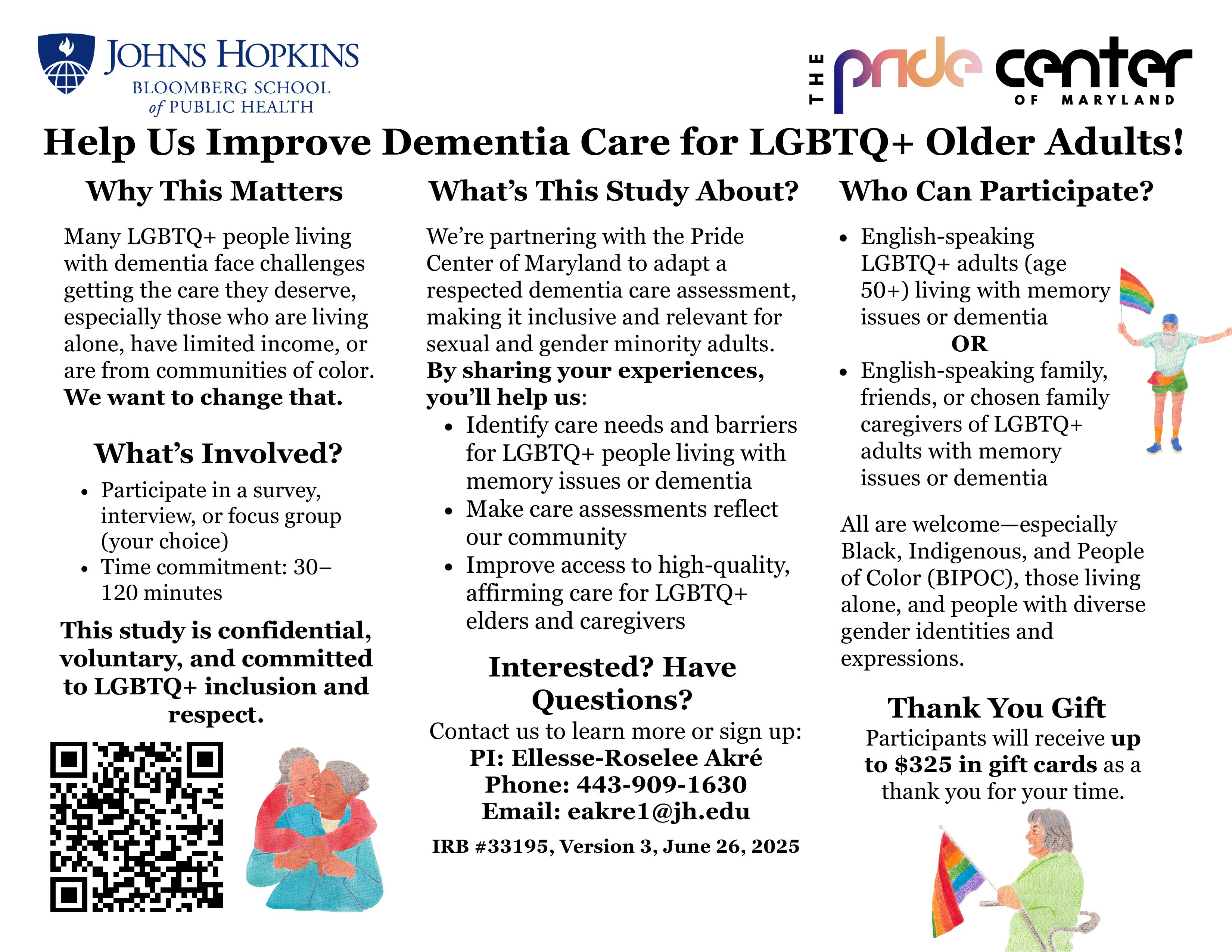
This study aims to improve access to high-quality, affirming care for LGBTQ+ elders and their caregivers by providing recommendations to update current dementia care needs assessments used by healthcare providers. These assessments help providers understand the needs of people living with dementia and their caregivers. Current assessments do not capture the unique needs and barriers faced by LGBTQ+ patients living with dementia and their caregiver. This study's outcomes will help care assessments reflect the lives and strengths of our community.
This study involves a focus group, interview, and survey. We will bring together focus groups to understand what changes are needed, followed by interviews to improve and clarify the revised assessments. Finally, we will give the updated tool to a selected group of LGBTQ+ elders and caregivers. We will test how valid, reliable, and acceptable it is.
Study Type:
Qualitative
IRB Approved:
Yes
Target Audience:
English-speaking LGBTQ+ adults (age 50+) living with memory issues or dementia OR English-speaking family, friends, or chosen family caregivers of LGBTQ+ adults with memory issues or dementia
Target Sample:
30
How to Apply:
Visit website
Study Contact:
Dr. Ellesse-Roselee Akré
eakre1@jh.edu