GLMA: Health Professionals Advancing LGBTQ Equality
The Invisible Parent: A National Study of Non-Birthing Caregivers in the Perinatal Period
Overview:What is the mental health experience of the parent who didn’t give birth?
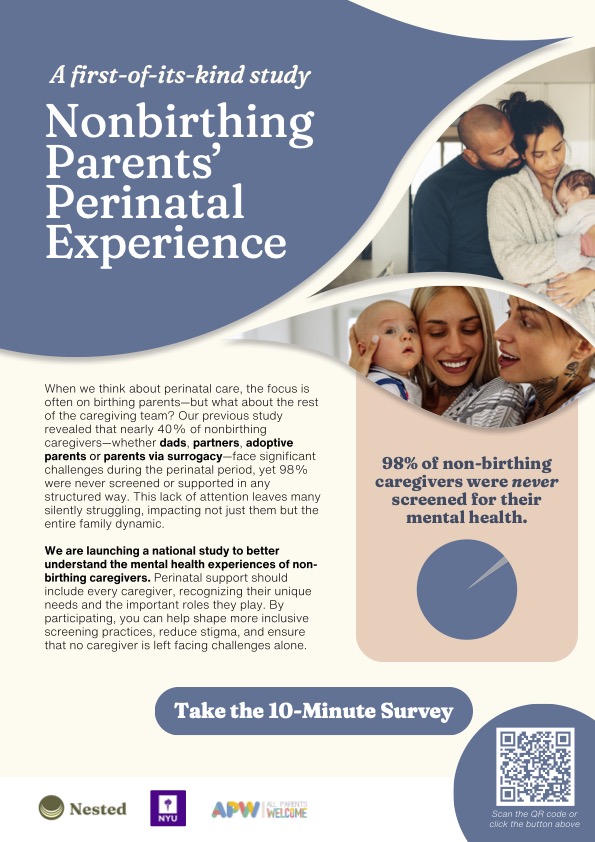
Most research on perinatal mental health focuses almost entirely on the person who gives birth. While this work is essential, it leaves a major gap in our understanding of the broader caregiving system. Non-birthing caregivers, including fathers, adoptive parents, LGBTQ+ parents, and partners, often navigate profound emotional, relational, and logistical changes during pregnancy and the early years of parenting, yet their experiences remain largely invisible in the data.
This national study aims to better understand the mental health, caregiving roles, and support needs of non-birthing caregivers with children under age five. The findings will help inform more inclusive research, clinical practices, and support systems that recognize the full caregiving ecosystem surrounding young children.
Participation involves a short survey (about 10 minutes). Participants will also have the option to share their contact information if they are open to participating in a follow-up interview to more deeply explore their experiences.
This study has been reviewed and approved by the New York University Institutional Review Board (IRB).
Study Type:
Mixed Methods
IRB Approved:
Yes
Target Audience:
Non-birthing caregivers of children under age five. In this study, non-birthing caregiver refers to a parent or primary caregiver who did not physically give birth to the child but played a significant caregiving role during pregnancy, postpartum, or early childhood. This includes fathers, partners of birthing parents, adoptive parents, and LGBTQ+ parents (e.g., non-gestational mothers or parents in same-sex couples).
Target Sample:
1000
How to Apply:
Click this link to access the survey: https://nyu.qualtrics.com/jfe/form/SV_eX2lWAw3wkWCorI
Study Contact:
Robin Neuhaus
rn1217@nyu.edu