GLMA: Health Professionals Advancing LGBTQ Equality
Mental Healthcare Worker Discrimination
Overview:Much research focuses on stigma and issues related to health care provision from the healthcare provider toward the patient. However, less is known about how stigma and discrimination from patient toward the mental healthcare provider affects the clinician's mental health. Much research exists that demonstrate the stigma and negative attitudes of healthcare clinicians toward those experiencing mental illness, but less information about how patients treat their mental health clinicians is available. Many clinicians in the mental healthcare profession are taught or instructed to ignore direct personal comments that are offensive, as their patients may be experiencing a condition that causes them to lash out or say something they don't mean. However, discriminatory comments can have adverse effects on career, work environment, and health. Unfortunately, little is known about how often these interactions occur in the mental healthcare setting (from patient to mental health provider) and whether there is a system in place to address the consequences of these interactions. Mental healthcare clinicians are often instructed to ignore or attempt to avoid taking discrimination personally in the interest of helping their patients and to avoid depriving them of much needed care. Although coping and resilience is important, it is also important that professional support exists to help mental health professionals cope with this behavior and that complaints about discrimination are not met with a response that downplays or minimizes their emotional response to these negative interactions. Unfortunately, lack of clear guidance related to discrimination in the workplace can perpetuate the issue, and dismissiveness or lack of support for individuals facing discrimination can contribute to increased psychological distress. For example, in a study of college students, those who used social support to cope with perceived personal discrimination were less likely to report helplessness and engage in more collective action related to coping. This could potentially translate to the effects of workplace policy that supports and normalizes open discussion about discrimination for mental healthcare workers. This type of policy, in turn, may buffer the effects of discrimination on psychological and mental health outcomes. Bringing this issue and the potential support structures that could mitigate the effects of discrimination could contribute to increased workplace policy aimed at decreasing the burden of discrimination on mental health and burnout.
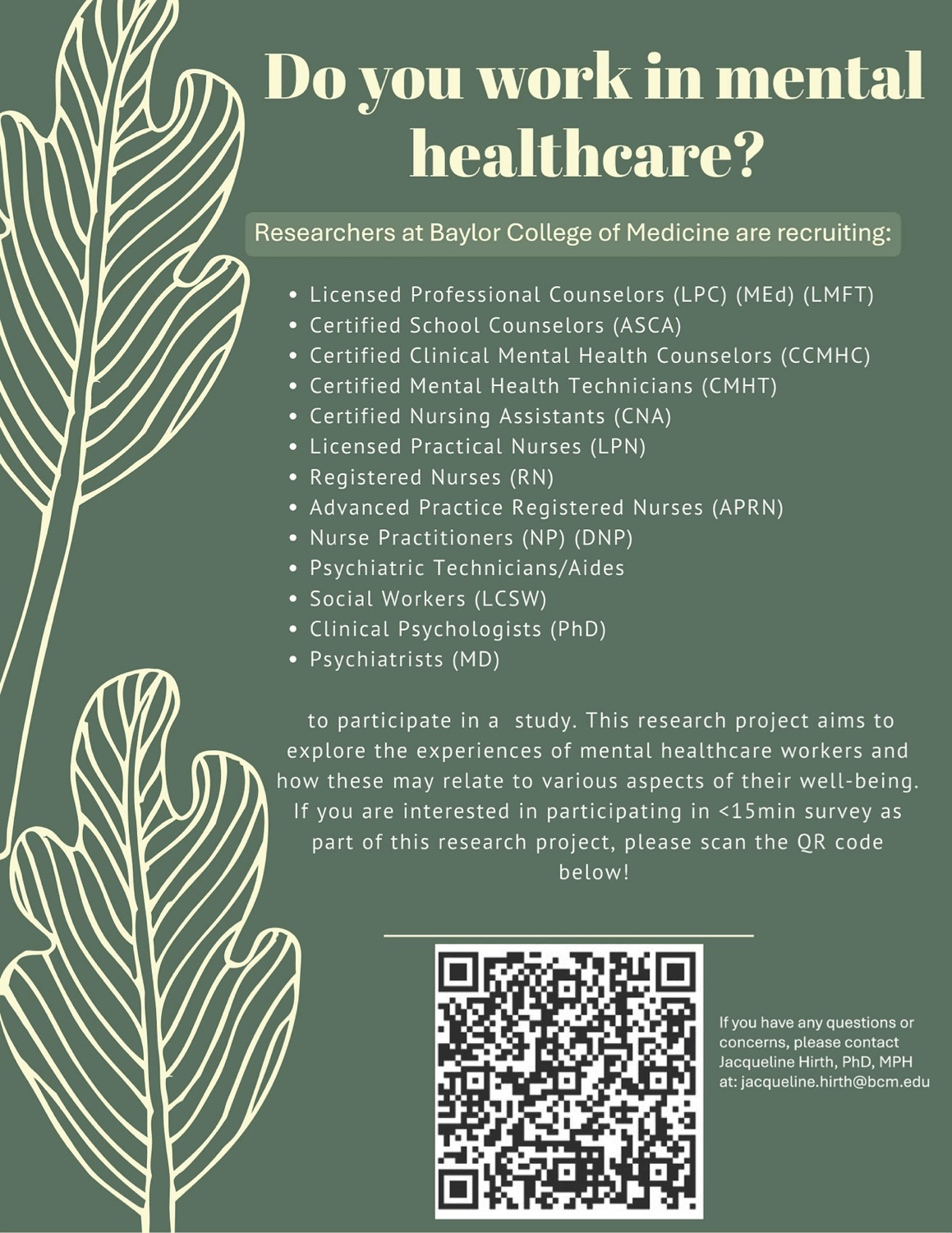
The purpose of this study is to 1) examine how commonly discrimination is perceived by mental health care professionals from their clients/ patients; 2) evaluate the association of perceived discrimination from patient/client toward mental healthcare worker with the outcomes: depressive symptoms, anxiety, and burnout; and 3) investigate whether having any established workplace policy in place regarding discrimination affects any observed associations between perceived discrimination and outcomes.
Study Type:
Quantitative
IRB Approved:
Yes
Target Audience:
Mental Healthcare professionals
Target Sample:
1000
How to Apply:
Using the QR code or the web link to the survey
Study Contact:
Jacqueline Hirth
jacqueline.hirth@bcm.edu